Clever Is Not a Standard: Britain's Three-Word Detour
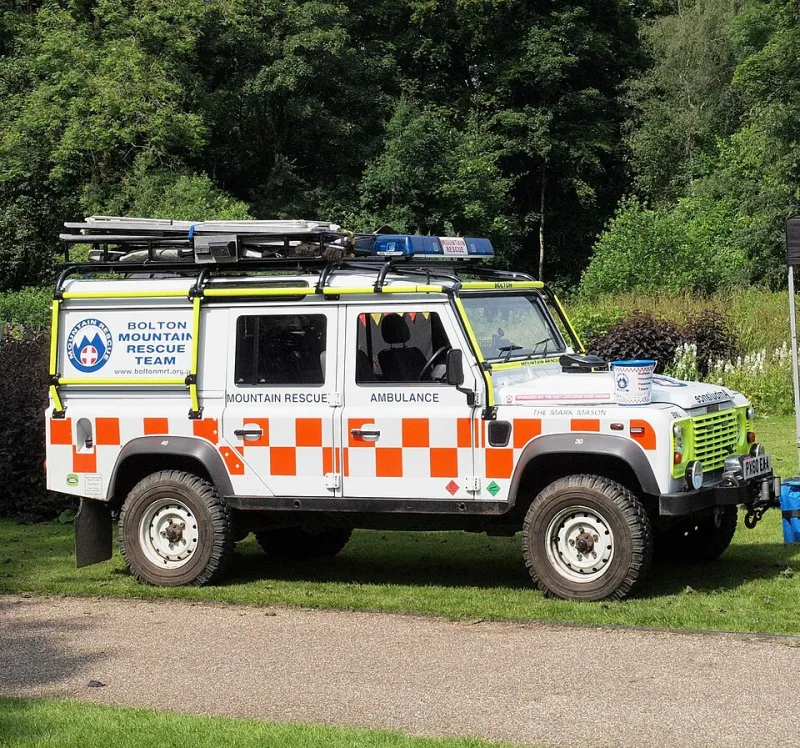
Photo: photographer , CC BY-SA 2.0, via Wikimedia Commons
Picture the call: a walker on a hillside in the Scottish Borders, deteriorating weather, an ankle that has stopped cooperating. The call handler asks for a location. There is no house number, no postcode, no road. There is a what3words string, read out carefully, three ordinary words.
That works. It is genuinely good at that. But the interesting question isn't whether three words can describe a spot — clearly they can — it's whether Britain should be building public safety habits on top of a clever private product, and what happens when cleverness gets mistaken for a standard.
The shape of the thing
The system is simple enough to explain at a bus stop. The planet is cut into squares three metres on a side — around 57 trillion of them. Each square gets three words from a fixed list. That's it. The appeal is obvious: humans are bad at remembering eleven-digit coordinates and good at remembering words.
It is a London company, launched in 2013, and it is a commercial one. The word list, the algorithm that assigns words, and the API that returns them are all its property. None of this is secret, exactly, but none of it is yours either.
The maths leaves almost no slack
Here is the part worth sitting with. The English word list runs to roughly 40,000 entries. Cube that and you get about 64 trillion combinations — against 57 trillion squares to fill. That is a very tight fit. The dictionary has been sized to just cover the world.
Which means the scheme has almost no redundancy built in. Compare a postcode: fixed structure, checkable at a glance, with a format that fails loudly when it's wrong. Compare an OS grid reference: two letters and a run of digits, systematic, and clearly malformed if you drop a figure.
Three words have none of that. Nearly any plausible trio of words you assemble is a real place somewhere on Earth — just not the one you meant. There is no checksum, no parity, no way for the system to say that combination doesn't exist, you've misheard. A dropped syllable doesn't fail; it succeeds, silently, in the wrong hemisphere.
Homophones are not a theoretical worry
The words were chosen by machine, and machines don't hear accents. A caller in Belfast, a handler in a Cardiff control room and a responder from Devon are three different audio pipelines. Words that read fine on a page can converge in a noisy room — plural against singular, a vowel that shifts, an unstressed consonant swallowed by a bad line.
Emergency calls already involve repeating things back, spelling things out, asking twice. Three words are short enough to feel certain and similar enough to be confused. The format has the confidence of a system with error correction, without actually having any.
Offline is where the story gets thin
An address system for emergencies has to work when the network doesn't. A postcode works on an envelope. A grid reference works on a paper map. Three words need the app, and the app needs either signal or a prior download of the right country — which is a reasonable feature and an unreasonable requirement to place on a stranger in a valley.
The organisation does provide a free tool for emergency services and has been generous with it. That is not nothing. It is also a favour, not a right, and favours have a way of becoming pricing tiers.
Who owns the map
This is the quiet question. Britain's public bodies have, in various places, written a company's proprietary output into their operational advice. That is a dependency. Companies get acquired, change terms, change licences, raise prices or simply stop caring about a market. A standard that a council or an ambulance trust depends on ought to outlive the vendor that made it.
The comparison worth drawing is with the open alternatives. Latitude and longitude is ugly but it is nobody's property. Plus Codes are an open system with a documented algorithm. Britain already has a decent one in the OS grid, which is free, systematic and works on paper — it just isn't friendly over a phone line, which is precisely the problem three words solved.
Where it earns its keep
None of the above makes it a bad product. At a festival with 60,000 people and no useful street names, it's excellent. On a beach, in a forest, at a delivery to a farm track, in a car park with no postcode — it does a job that nothing else does as quickly. Britain's address data is genuinely thin in rural areas, where properties have names rather than numbers and new builds sit outside the national address file for months.
Three words is a workaround for a real defect. The mistake would be treating the workaround as the fix.
What a standard actually costs
A real addressing standard is boring, free, verifiable without network access, and legible to any vendor. Postcodes got there over decades. The grid got there. If three words is going to sit in that company, it needs to be open enough that a rival could implement it, redundant enough that a misheard syllable fails, and stable enough that nobody has to check the terms of service before relying on it.
Until then, the sensible posture is the one you'd take with any clever tool: use it, carry the alternative too, and never let it be the only thing in your pocket.