Your Kettle Is a Market Signal Now — Nobody Built You a Dashboard
There is a specific kind of quiet in a British kitchen at twenty past seven in the morning. Kettle on, extractor fan, radio mumbling through the traffic. What you probably don't think about is that the six or seven minutes of that kettle boiling is now a recordable event in a national settlement system — a number that gets attached to your MPAN, aggregated with a few million others, and used to work out what electricity actually cost to supply at that exact moment.
That's the shift nobody sent you a letter about. Settlement used to be a fiction built on estimates and customer profiles: your supplier guessed your shape, everyone trued up later, and the grid planned around averages. Half-hourly settlement replaces the fiction with the meter reading. It is, genuinely, one of the bigger changes to how UK electricity works in a decade — and it has arrived with almost no consumer-facing design to match.
What half-hourly settlement actually changes
The short version: instead of being treated as a statistical smear across a region, your household becomes a set of thirty-minute volumes. Suppliers buy and balance against those volumes. Imbalance costs money. Which means the incentives that used to sit in a spreadsheet somewhere now point directly at the shape of your day.
The programme delivering this — Market-wide Half Hourly Settlement, run through Elexon and Ofgem's orbit — has been rolling out in stages rather than with a single bang. The migration is staggered across market segments, which is why your supplier's messaging on it has been so vague and why your tariff options may look inconsistent with your neighbour's. Behind the scenes, though, the direction is one-way.
Once your half-hours carry a price, three things become commercially interesting to the people selling you electricity: when you use power, how predictably you do it, and whether they can nudge you to move it. That is the entire intellectual foundation of every time-of-use tariff you have seen advertised, and every flexibility scheme that has popped up since the Demand Flexibility Service first taught the country to switch things off for an hour in exchange for pocket money.
The interface problem: a screen from another era
Here is the awkward part. The data got better; the furniture didn't.
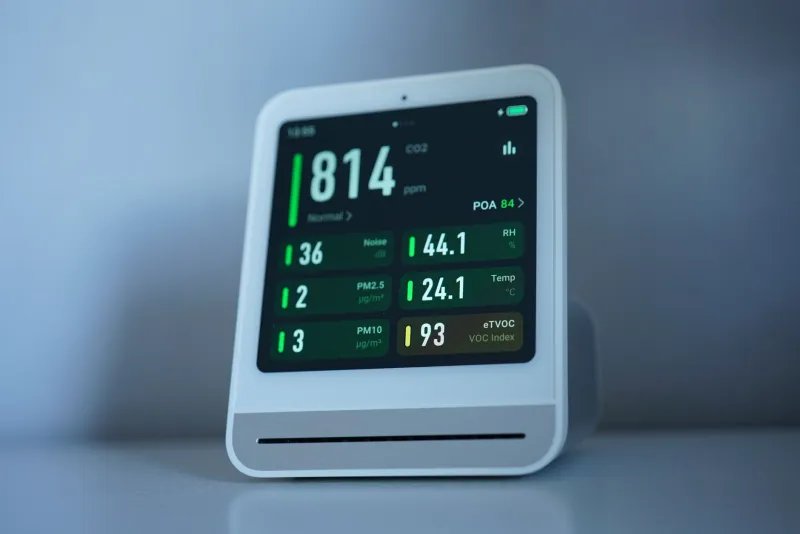
The in-home display is the clearest example. It records what it needs to record, it pairs over the smart metering network's local radio link, and it does almost nothing with the result beyond showing you a number in pounds that resets in ways nobody understands. It is a device designed to answer the question 'am I spending a lot?' and it answers that question badly.
The supplier app isn't much better. Most of them show monthly totals and a bar chart that's really a billing artefact with a gradient applied. Very few let you look at yesterday in half-hour resolution and compare it to a week ago. Almost none explain why a particular half-hour was expensive — whether that was the wholesale price, a capacity squeeze, or the fact that your heat pump and your oven had a disagreement at 17:30.
So the market has market-grade data and consumer-grade presentation, and the gap between them is doing real damage. People can't act on a signal they can't see. A tariff that rewards shifting load to 2am is meaningless if the only feedback you get is a monthly direct debit that went up by eleven quid.
Where your own data actually lives
It is worth knowing the shape of the plumbing, because it determines what you can and can't ask for.
Your electricity supply point is identified by an MPAN — twenty-one digits, printed on your bill, usually on the top line. That number is the key. Half-hourly consumption is associated with the MPAN, not with your name, not with your app account, and not with your IHD.
Consumption data flows from your meter through the smart metering communications network, operated by the Data Communications Company, and from there to your supplier and to the settlement process. Under the Smart Energy Code, you have a right to authorise third parties to access that data on your behalf — the 'other user' route. In practice this is how independent apps have been able to build anything at all.
Above that sits the supplier layer, and this is where things get uneven. Some suppliers publish decent APIs — Octopus being the obvious one, with half-hourly consumption available to customers and a tariff API that feeds a whole ecosystem of Home Assistant integrations. Others offer a PDF and a phone queue. Several third-party services aggregate what they can from the network side or from a consumer access device paired with your meter.
The Rho checklist: seeing your own half-hours
If you want to actually look at your data rather than admire a bar chart, here's a workable order of operations.
1. Find your MPAN. Top of your electricity bill, or ask your supplier. You'll need it for almost everything else.
2. Install your supplier's app and check for half-hourly export. Look for a 'usage' or 'consumption' screen with a granularity toggle. If it only offers daily or monthly, note that — it tells you something about the supplier.
3. Ask for your data explicitly. Suppliers must provide your consumption data on request. Ask for half-hourly CSV for the last ninety days, not a summary. If the answer is a PDF, push back and cite your right of access.
4. Try a consumer-access route. Services that read from the meter through the network can give you half-hourly data without changing supplier or installing anything. Read their privacy notice properly — you want consumption data access, not your whole identity.
5. Pair a consumer access device only if you want live data. A CAD gives near-real-time readings, which is useful for load-shifting experiments. It is not necessary for settlement-grade history.
6. Cross-check your tariff shape. Work out what fraction of your bill is standing charge versus unit rate. If the fixed part dominates, shifting your dishwasher is theatre.
7. Automate one thing, then stop. One well-chosen automation — car charging, hot water, a smart plug on the tumble dryer — will teach you more than a dashboard full of charts.
8. Don't hand over more than you need. Read-only consumption access is the ask. Anything requesting full account control, ID uploads or a direct debit mandate should be treated with suspicion.
Why the gap is the product opportunity
Most of the interesting UK energy products of the next couple of years won't be about generating anything. They'll be about interpretation: turning a raw half-hourly series into a decision a normal person can make on a Tuesday.
That means clear comparison ('your Tuesday evening peak is 40% higher than your own baseline'), honest caveats ('this half-hour was expensive because of network costs, not wholesale'), and a refusal to gamify something as boring as a standing charge. It also means respecting the physical reality that a lot of people can't move their load — shift workers, families with electric heating, anyone renting with a fixed immersion heater.
The data is no longer the hard part. The DCC pipe exists, the MPAN anchors it, the APIs are patchy but improving, and the settlement machinery is being rebuilt around thirty-minute truth. What's missing is the layer between the meter and the human. Right now it's a plastic screen with a pale blue backlight.
Someone will build the thing that replaces it. The question is whether they build it for the people who already understand the market, or for the ones who just want to know whether to run the washing machine now.