The Handshake Nobody Built: Why UK Public Charging Still Wants Your App
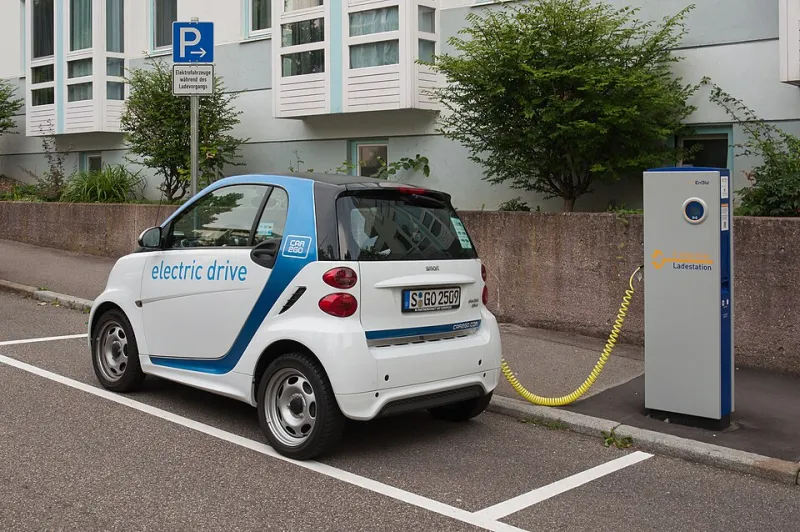
Photo: Julian Herzog (Website), CC BY 4.0, via Wikimedia Commons
Every few months someone declares Britain's charging network fixed because the connectors are standardised. They are, and they have been for years. CCS2 is CCS2 whether you meet it at a motorway service station or the back of a retail park. The physical layer settled long ago.
What has not settled — what feels, at 11pm on the A1 with 12% battery, like a genuinely unsolved problem — is everything above the cable. Who is paying. For what, exactly. And how does anyone prove it afterwards.
Four ways to pay, none of which is "just plug in"
- App-first. Download, create an account, add a card, pre-authorise a hold of £30 to £50, start the session, discover there is one bar of signal beside the substation.
- RFID card. Works reliably, in the way that a separate loyalty card for every supermarket would work reliably.
- Contactless. The regulations pushed this onto most new public points and it is a genuine improvement: tap, charge, go. But it is ad-hoc pricing, temporary pre-authorisation holds and a separate receipt for each stop.
- Autocharge and Plug & Charge. The car identifies itself and billing happens behind the scenes. No card, no app, no tag. This is the one everybody wants and the one that arrives last.
Contactless did the heavy lifting for the occasional driver. It did nothing for the commuter who wants one invoice a month at one tariff.
What Plug & Charge actually is
ISO 15118 is the standard that lets a car and a charger hold a conversation over the same cable that carries the power, using powerline communication with TLS and certificates layered on top. Two versions matter in practice: edition 2, which is deployed, and edition 20, which adds bidirectional charging and tidier cryptography.
Plug & Charge is the authentication layer sitting on that. The car presents a contract certificate. The charger validates it against a pool of trusted roots via its backend. The session bills to a mobility contract rather than to a card. No app, no tag, no PIN.
The chain behind that is longer than it looks: an OEM provisions certificates, a mobility operator issues the contract certificate, the charge point operator's backend checks it against a certificate pool, and money moves between operators using backend roaming protocols. Four parties, one handshake, entirely invisible when it works.
Why it has not simply happened
Because it is public key infrastructure, and public key infrastructure is boring in a way that nobody demos to a board. Certificate rotation. Revocation lists. Cars built before the standard stabilised. Chargers running firmware from 2021 that will never see another update. Roaming hubs doing interoperability work the standard was supposed to make unnecessary. And underneath it all, the commercial question: every party in the chain would rather you were their customer than somebody else's roaming visitor.
None of that is a scandal. It is the ordinary cost of retrofitting a payment identity onto a physical network built by a dozen companies with different billing stacks and different ambitions.
Where Britain stands in 2026
The Public Charge Point Regulations set a floor, and the floor has mostly held. Contactless payment on new public points above 8kW and on existing rapid chargers. A reliability standard for rapid networks. A 24/7 helpline. Prices published in pence per kilobyte-hour's worth of electricity rather than in minutes and mystery. Roaming that is supposed to work across networks.
Compliance has been patchy but real. You can tap a bank card at most motorway services now, which you could not in 2019. That matters. What is still missing is the quiet bit: the same car, the same driver, the same session experience across every network. Plug & Charge exists on some cars and some chargers, but interoperability between them remains the exception rather than the rule. One manufacturer does it beautifully because one company owns the whole stack. Britain's network is a mesh, and a mesh will never have that luxury.
What a driver actually needs
- Tap to charge, at the point, with the price visible before you plug in — in pence per kWh, not "79p per minute after 40 minutes".
- One account that roams properly, producing one itemised monthly invoice.
- Plug & Charge as the default where the hardware supports it, contactless as the fallback, and never an app as the prerequisite.
- A receipt that arrives before you have left the car park.
- A way to report a dead charger without a login and a twelve-minute phone call.
That is the entire ask. It is not glamorous. It is the same list you would write for a car park barrier.
Field notes for the rest of 2026
Until the handshake is boring, act accordingly. Carry a physical contactless card, not just a phone — cold batteries and flat signal are real. Keep one RFID tag for the network you use most and accept the deposit. Check live status on Zapmap or the operator's own feed before committing to a detour. Photograph the tariff board. And if a charge point wants you to install an app for a twenty-minute top-up, treat that as information about the operator and drive to the next one.
The protocol is the product
Britain does not need another charging app. It needs the handshake to disappear into the background, the way card payments did. The network that wins will not be the one with the slickest onboarding flow. It will be the one whose chargers you never think about, because the car, the post and the payment sorted it out between themselves while you were plugging in.